Adult · Class III
The upper jaw that sat just behind the lower
His upper teeth sat slightly behind his lower ones, enough that biting was a struggle and he felt self-conscious smiling. The skeletal discrepancy was mild — the kind that can be camouflaged with orthodontics rather than treated as a surgical case — but it also involved a narrow upper arch and a lower midline that had drifted off-centre.
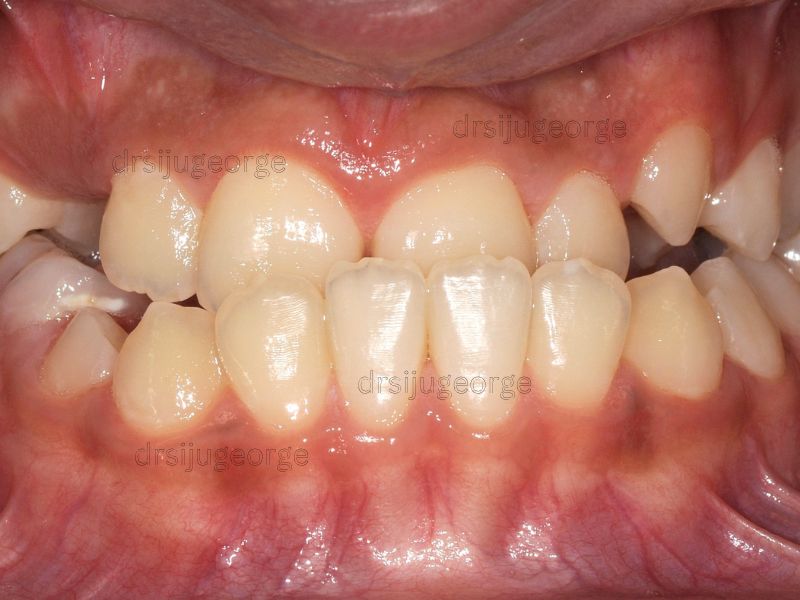
Before treatment — in their own words
His account: he had a hard time eating because he could not bite properly, and because his upper teeth sat inside the lowers he felt a little conscious when he smiled. A functional complaint and a cosmetic one, from the same underlying bite.
The clinical picture
Examination showed a mild skeletal Class III. The upper midline was on, but the lower midline had shifted to the left, with a mild mandibular deviation, and the upper arch was constricted. The narrow upper arch was part of why the upper teeth sat behind the lower — widening it would let them come forward into a better relationship.
The plan
Invisalign to develop the upper arch, bring the upper teeth into a positive relationship with the lower, correct the shifted lower midline, and address the mild deviation — camouflaging the mild skeletal Class III without surgery.
The outcome
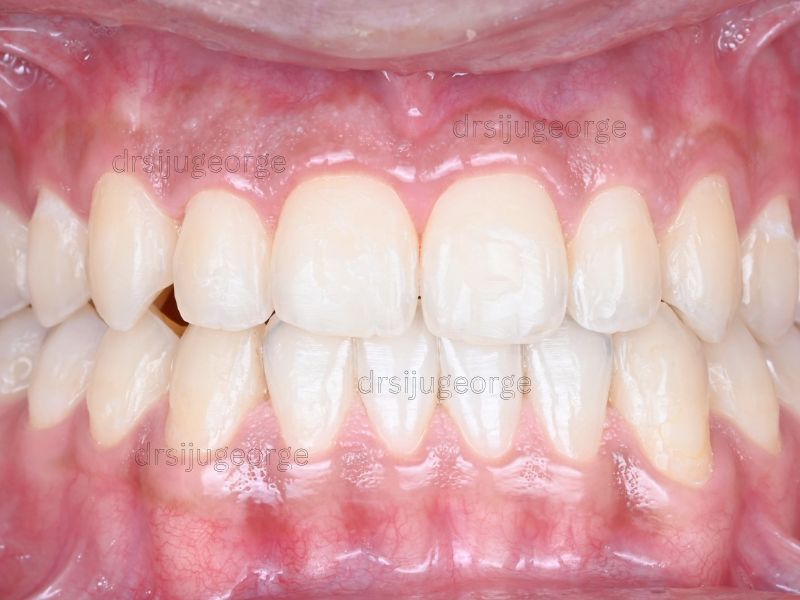
After sixteen months the upper arch was the right width, the upper teeth met the lower in a corrected relationship, and the midline was re-centred. Biting was comfortable and the self-consciousness about the smile resolved — all achieved orthodontically, without surgery.
Clinical notes (for dental professionals)
- Diagnosis: Mild skeletal Class III; constricted maxillary arch; lower midline shift (left) with mild mandibular deviation; upper midline coincident
- Treatment: Invisalign Comprehensive; maxillary arch development; midline correction; Class III orthodontic camouflage
- Auxiliaries: Class III elastics as indicated
- Extractions: None
- Duration: 16 months
- Retention: Vivera upper and lower; periodic review