Teen · Class III
The underbite that had been explained away for years
His mother had an underbite. His uncle had an underbite. Every dentist who had ever examined him had said the same thing: it runs in the family, there is nothing to do, come back when he is older and we will talk about surgery. He was seventeen when he came to see Dr. Siju George. Twenty months later, the underbite was gone. No surgery. No extraction. No waiting.
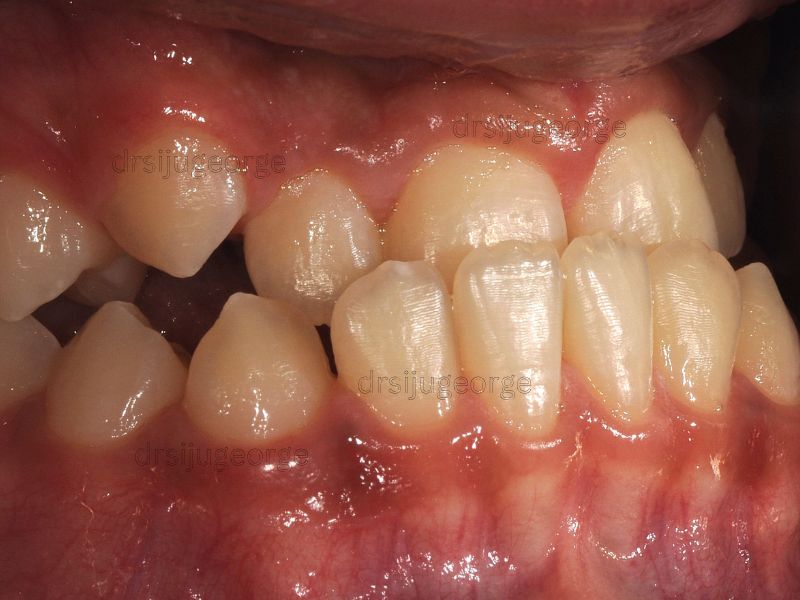
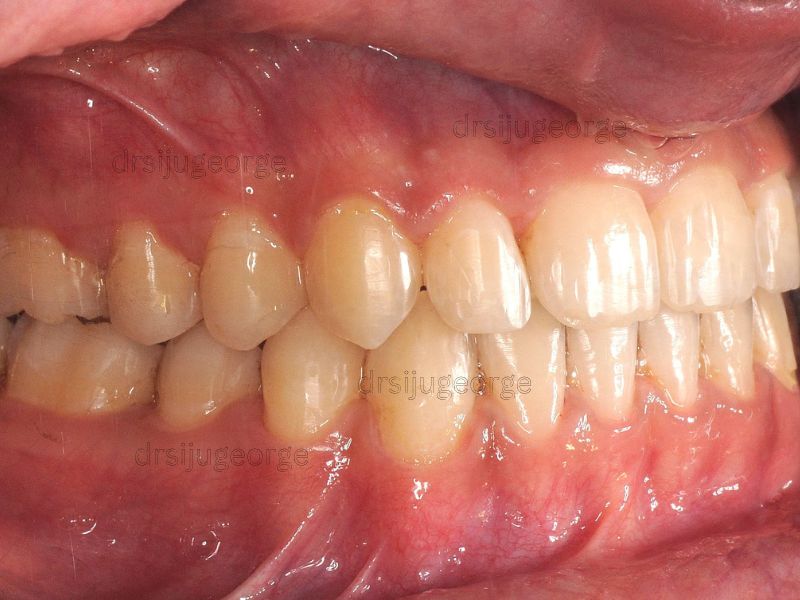
Before treatment — in their own words
He was seventeen, near the end of secondary school. His mother had brought him in partly because the university years were approaching and she wanted the opportunity settled before then. The mother was direct: she had an underbite herself, had always been told nothing could be done without surgery, had never had surgery, and now had a son with the same problem. She was not asking whether anything could be done. She was asking what specifically could be done, and on what timeline.
The son added one detail his mother had not mentioned: he found chewing on the left side more comfortable than the right, and had been doing this for so long it felt normal. He had not thought it was relevant until he mentioned it.
The clinical picture
Examination confirmed a Class III malocclusion. On habitual closure, the lower incisors were anterior to the upper. However — critically — when asked to close from rest position with the lips apart and no muscular guidance, the relationship improved substantially. This was the functional shift his chewing preference had been compensating for. The mandible was deflecting forward on closure due to premature occlusal contact at the canine region, which was then triggering an anterior slide. The underlying skeletal discrepancy, while present, was mild. This was a pseudo-underbite with a significant functional component — treatable with orthodontics alone.
The plan
Invisalign Teen Comprehensive with Class III elastics and upper arch proclination to create positive overjet and eliminate the functional shift. Once the premature contact was removed and the upper anterior teeth proclined past the lower incisors, the mandible would no longer deflect forward on closure. The true skeletal discrepancy — mild Class III — could then be camouflaged with dental positioning alone. The mother, who had been told surgery was her own only option twenty years earlier, sat quietly through the explanation and then asked why no one had ever assessed her bite this way. There was no good answer.
The outcome
After twenty months, the functional shift had been eliminated. Positive overjet was established. The molar and canine relationships were Class I. The lower incisors no longer protruded in front of the upper on closure from any position. His chewing preference had normalised by around month fourteen, which is often the clearest functional indicator that the shift has resolved. He began university in the autumn after debond. His mother came to the debond appointment. She spent most of it looking at the before photos.
Clinical notes (for dental professionals)
- Diagnosis: Class III with anterior crossbite; significant functional shift on closure; pseudo-underbite; mildly Class III skeletal; growth largely complete; healthy periodontium
- Treatment: Invisalign Teen Comprehensive; Class III elastics; upper anterior proclination to eliminate functional shift; orthodontic camouflage
- Auxiliaries: Class III elastics (lower canine to upper molar); upper incisor torque attachments; finishing elastics
- Extractions: None
- Duration: 20 months
- Retention: Vivera upper and lower (indefinite); lower bonded retainer 33 to 43; annual review for skeletal monitoring recommended