Teen · Class III
The boy who grew into his jaw
His lower jaw had been the dominant feature of his face for as long as his parents could remember. Three different clinicians had told them the same thing: wait for growth to stop, then surgery. Dr. Siju George saw something different. Twenty months of Invisalign Teen resolved the Class III relationship without a single surgical appointment.
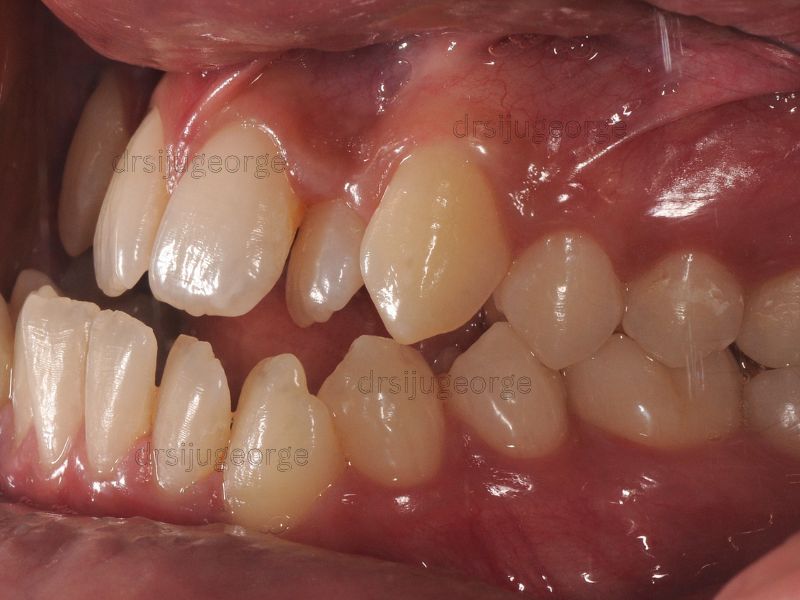
Before treatment — in their own words
He was fourteen when his father brought him in for a second opinion. The family had already been to three orthodontists. All three had said the same thing: his jaw discrepancy was skeletal, it would worsen as he grew, and surgery was the only real option once he reached adulthood. His father, a practical man who asked direct questions, wanted to know whether that was actually true. Was surgery the only option, or the easiest recommendation?
The boy himself was quiet about the matter. He was used to adults discussing his jaw as though it were an engineering problem. He had not volunteered that he found eating difficult in certain social situations, or that he avoided laughing openly with his mouth wide because he was conscious of how his lower teeth appeared from certain angles. His father mentioned it for him.
The clinical picture
The presentation was Class III with an anterior crossbite. The lower incisors were in front of the upper incisors on closure. Critically, there was a functional component: when asked to close gently from rest position rather than from habitual occlusion, the anterior relationship improved. This suggested that a significant portion of the apparent Class III was positional rather than purely skeletal. Cephalometric analysis confirmed a mildly Class III skeletal base, but well within the range that dental camouflage can address. He was still growing, and Class III elastics could work with that growth.
The plan
Invisalign Teen Comprehensive with Class III elastics worn from the lower canines to the upper molars. This elastic configuration applies a backward force to the lower arch and a forward force to the upper, encouraging proclination of the upper anteriors and retraction of the lower anteriors. Upper arch expansion was incorporated to improve the transverse relationship. The plan was discussed fully with both father and son. The father asked three specific follow-up questions and was satisfied with the answers. Treatment started the following week.
The outcome
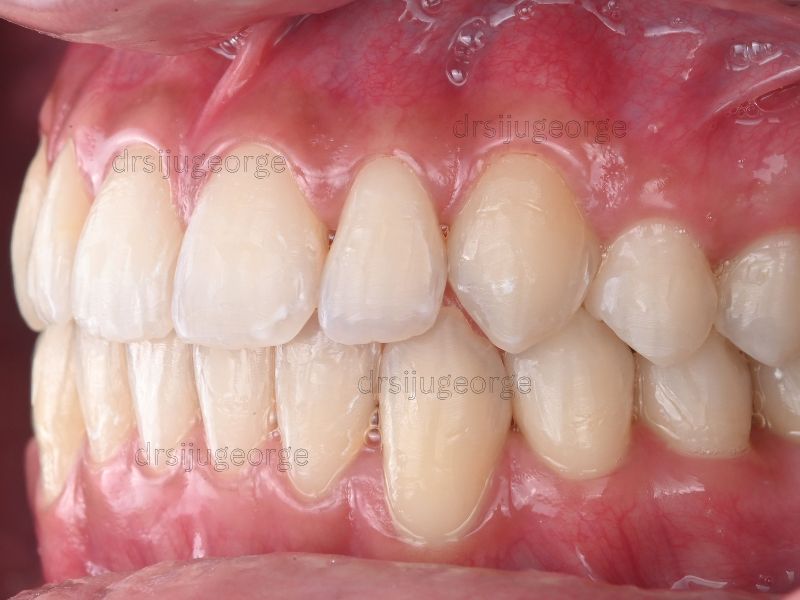
After twenty months, the anterior crossbite had been fully resolved. The incisors now demonstrated a normal positive overjet. The Class III molar and canine relationships had been corrected to Class I. The functional shift, which had been exaggerating the apparent severity of the case at first examination, was eliminated as the dental arches came into proper relation. His profile changed measurably. His father sent a message six weeks after debond: the boy had started smiling differently. More openly. That was the word he used — openly.
Clinical notes (for dental professionals)
- Diagnosis: Class III with anterior crossbite; functional shift on closure; mildly Class III skeletal; growth remaining; good periodontal health
- Treatment: Invisalign Teen Comprehensive; Class III elastics (lower canine to upper molar); upper arch expansion; orthodontic camouflage without orthognathic surgery
- Auxiliaries: Class III elastics full-time; upper expansion built into aligner sequence; anterior torque control attachments
- Extractions: None
- Duration: 20 months
- Retention: Vivera upper and lower (indefinite); lower bonded retainer 33 to 43; long-term monitoring of skeletal growth advised