Adult · Underbite
The bite that wore down her teeth year by year
Her referring dentist described the wear pattern on her front teeth as consistent with an edge-to-edge bite. She had not known she had an underbite. The wear pattern told a story that a decade of routine dental care had missed. Fourteen months of Invisalign corrected it.
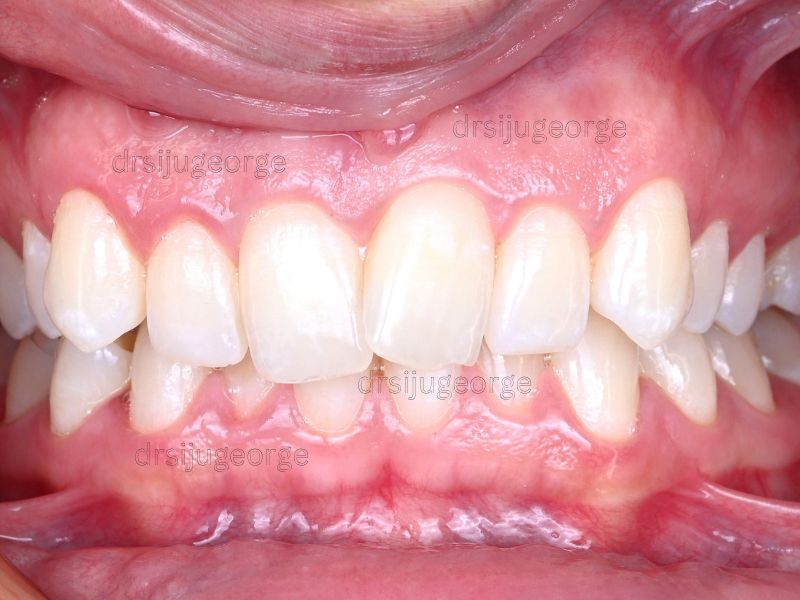
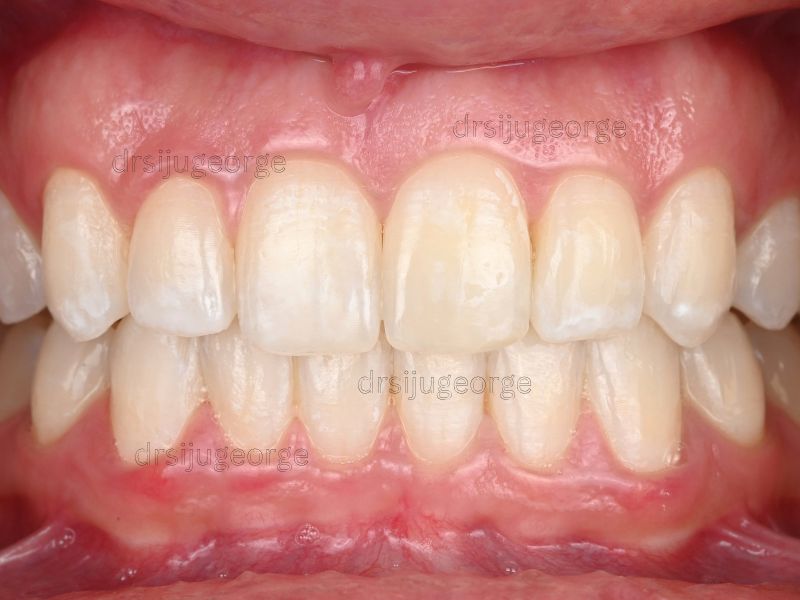
Before treatment — in their own words
She had been going to the same dentist for over a decade. Every check-up, the wear on her front teeth was noted. She had been advised to use a softer toothbrush, to reduce acidic foods, to try a mouthguard. The enamel had continued to erode, slowly but consistently, year after year. It was only when she changed dental practices and her new dentist examined her bite specifically that someone identified the cause: an edge-to-edge Class III relationship where her upper and lower front teeth met end-on, grinding against each other with every bite and every jaw movement.
She had never been told she had an underbite. She would have treated it years earlier if she had known.
The clinical picture
The bite was edge-to-edge in the anterior region, with the lower incisors in a position that created direct occlusal contact against the upper incisal edges rather than the palatal surfaces. This contact pattern had produced measurable wear on both upper and lower incisors. The posterior occlusion was broadly Class I. There was no significant skeletal component — the relationship was primarily dental, with some lower incisor proclination contributing to the edge-to-edge contact. The underlying bone structure did not require surgical intervention.
The plan
Invisalign Comprehensive treatment was planned to retract and upright the lower incisors, removing the edge-to-edge contact and establishing a normal overbite and overjet relationship. Bite ramps were incorporated to prevent the lower incisors from contacting the worn upper edges during treatment, which would otherwise perpetuate the wear mechanism during aligner wear. Class III elastics reinforced the dental compensation movements. The treatment did not restore the lost enamel — that would be addressed by the referring dentist after the bite was corrected — but it stopped the mechanism causing the loss.
The outcome
Fourteen months after starting, a normal overbite and overjet had been established. The edge-to-edge contact was gone. The lower incisors had been uprighted into a stable position. The referring dentist subsequently performed composite bonding on the worn upper incisal edges to restore the tooth dimensions, with the corrected bite now protecting those restorations from the same forces that had worn the original enamel away.
A Vivera retainer was fitted with lifelong wear instructions. The wear problem, which had accumulated over a decade, was stopped in fourteen months.
Clinical notes (for dental professionals)
- Diagnosis: Edge-to-edge Class III dental relationship; anterior incisal wear upper and lower; lower incisor proclination; posterior Class I; no significant skeletal component
- Treatment: Invisalign Comprehensive; lower incisor uprighting and retraction; Class III camouflage
- Auxiliaries: Bite ramps throughout treatment; Class III elastics; attachments for lower incisor torque control
- Extractions: None
- Duration: 14 months
- Retention: Vivera; referring dentist carried out composite edge bonding post-debond to restore worn incisal surfaces