Adult · Spacing
The gaps that came back years after braces
She had worn fixed braces in her teens and remembered the day they came off — her teeth were straight. What no one had explained was that teeth keep their old habits, and without lifelong retention the spaces can drift back. By the time she came to see Dr. Siju George, the small gaps had returned across her smile, and she had stopped showing her teeth in photos.
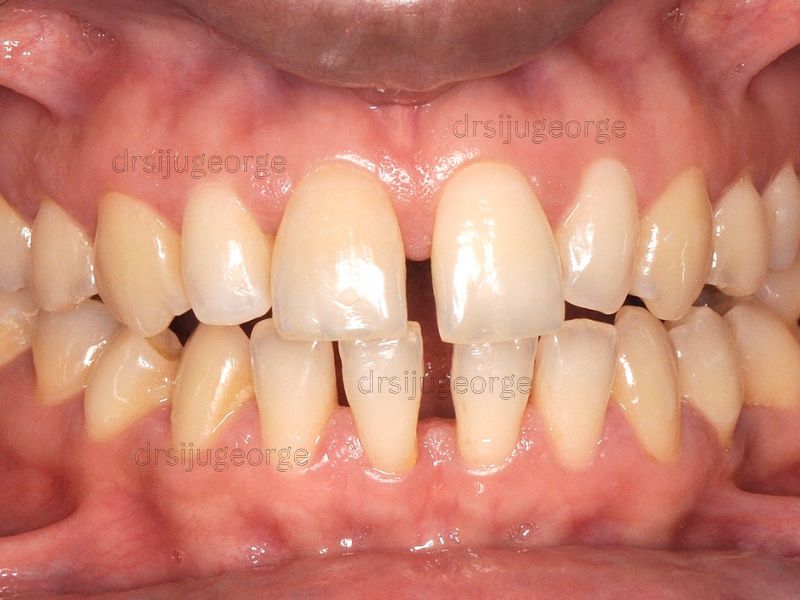
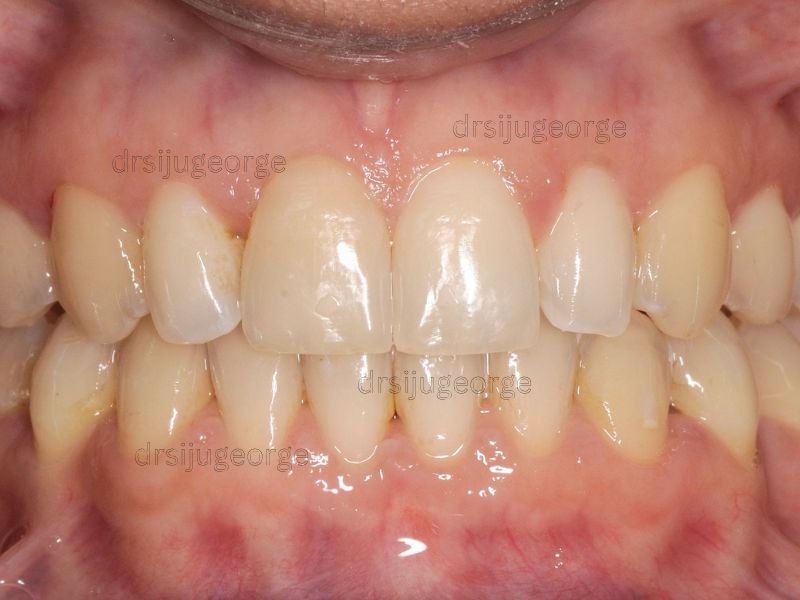
Before treatment — in their own words
Her own summary was simple: every time she smiled she noticed the gaps between her teeth, and she did not like them. She also mentioned that a couple of her lower front teeth felt sensitive — the gums had receded slightly around them, and cold drinks reached the exposed surface. The spacing was the reason she had come; the sensitivity was the thing she lived with daily.
The clinical picture
This was post-orthodontic relapse — generalised spacing that had reopened after earlier treatment, with no retention to hold it. A few of the back teeth had rotated out of their ideal position over the years, and there was mild gum recession on the two lower central incisors, which explained the sensitivity. The bite itself was workable; the case was about closing space, de-rotating the molars, and protecting the thin lower gum tissue rather than aggravating it.
The plan
A non-extraction Invisalign plan to close the spaces evenly, upright and de-rotate the affected back teeth, and finish the upper laterals to a clean line. Because the lower incisor gums were already receding, the tooth movements were planned to keep those roots well within the bone rather than tipping teeth outward. Cosmetic refinement of two of the upper teeth was reserved as an optional finishing step after alignment — done in the right order, not the other way around.
The outcome
After fifteen months the spacing was closed, the rotations were corrected, and the smile read as a continuous arc again. Crucially, fixed and removable retention was put in place this time — the missing piece from her first round of treatment — so the result holds. She left with the option of two small cosmetic finishes already mapped out, and the confidence to actually use them or not.
Clinical notes (for dental professionals)
- Diagnosis: Post-orthodontic relapse with generalised spacing; rotations of upper and lower first/second molars; localised gingival recession on lower central incisors; healthy occlusion
- Treatment: Invisalign Comprehensive, non-extraction; space closure; molar de-rotation; controlled lower incisor positioning to respect thin labial gingiva
- Restorative: Composite/laminate refinement of upper lateral incisors planned post-alignment (optional finishing)
- Extractions: None
- Duration: 15 months
- Retention: Fixed bonded retainer + removable Vivera, upper and lower (relapse case — emphasise lifelong retention)