Adult · Spacing
The professional who never wanted to talk about her teeth
She had spent years perfecting a closed-mouth smile for photographs. She managed meetings, presentations and client dinners without anyone noticing what she was doing. When she finally came in, she said she was tired of managing it. Sixteen months later, she had nothing to manage.
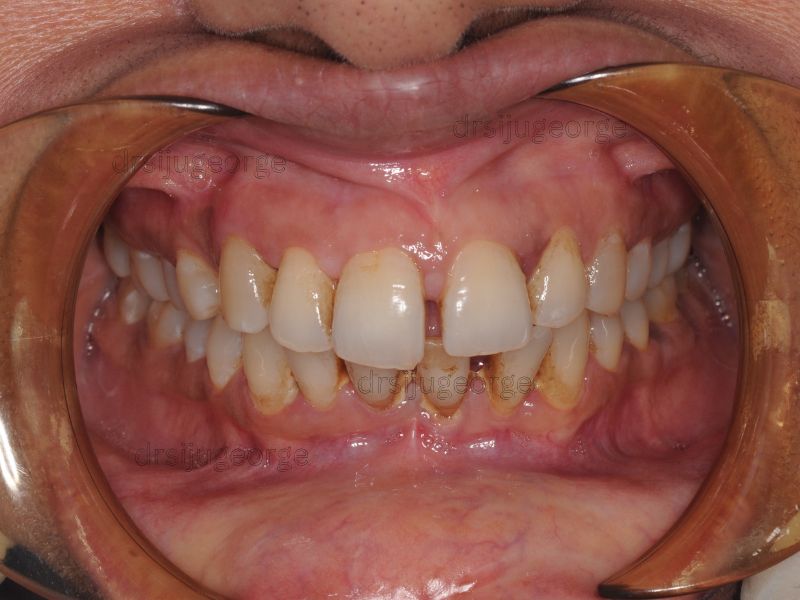
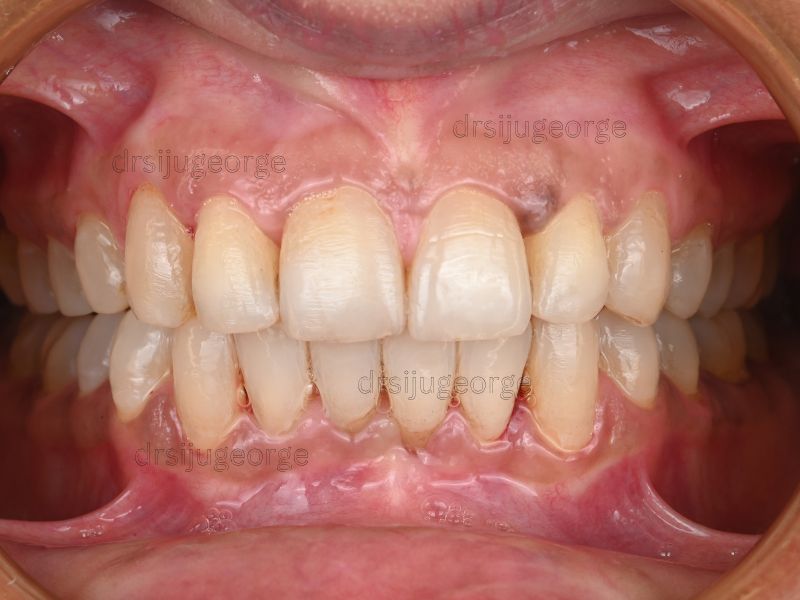
Before treatment — in their own words
She was in her mid-thirties and worked in a role that required constant communication with clients. She had developed, over years, a habit of speaking and laughing in a way that minimised the visibility of her teeth. She had become very good at it. So good, in fact, that no colleague or client had ever commented on her spacing. But she knew it was there, and the energy she spent managing it had quietly accumulated into something exhausting.
She had delayed treatment because she assumed it would be obvious — that braces would draw more attention than the spacing itself. Then a colleague came back from three months away looking different. She asked what had changed. The answer was Invisalign.
The clinical picture
Examination revealed generalised spacing affecting both arches, more pronounced in the upper anterior segment. The largest gap was a 2.5mm midline diastema between the upper central incisors, with smaller interdental spaces present between the laterals and canines. The bite relationship was Class I with normal overbite and overjet. A prominent labial frenum attachment was noted at the midline — relevant to the prognosis for diastema closure. Bone levels and periodontal health were excellent. The case was well within the range of Invisalign alone.
The plan
Invisalign Comprehensive was planned with tooth movements designed to close all spaces simultaneously, distributing the movements rather than concentrating change in one visible area. Attachments were placed to provide optimal force vectors for incisor translation. The labial frenum was assessed and monitored throughout treatment; a minor frenectomy was recommended post-treatment to support long-term diastema stability and was performed by the referring dentist after debond. The patient wore her aligners with strict compliance, changing them precisely on schedule throughout.
The outcome
All spacing was closed at sixteen months. The midline diastema was fully resolved. The patient attended her debond appointment in professional attire and remarked that not a single colleague had asked her about orthodontic treatment during the sixteen months she was wearing aligners. She was fitted with a bonded retainer behind the upper anterior teeth, in addition to Vivera, specifically to support long-term diastema stability.
She no longer manages anything at meetings. She simply smiles.
Clinical notes (for dental professionals)
- Diagnosis: Generalised spacing upper and lower arches; midline diastema 2.5mm; prominent labial frenum; Class I; healthy periodontium
- Treatment: Invisalign Comprehensive; generalised space closure
- Auxiliaries: Optimised attachments; no IPR required; light elastics for final occlusal settling
- Extractions: None
- Duration: 16 months
- Retention: Bonded retainer 13–23 plus Vivera; frenectomy post-debond by referring GDP for long-term stability