Adult · Crossbite
The crossbite that had been there since childhood
She had worn a mouthguard every night for ten years to protect her teeth from grinding. Her dentist had never investigated why she ground her teeth. The answer was a full bilateral crossbite that had been loading her jaw asymmetrically since childhood.
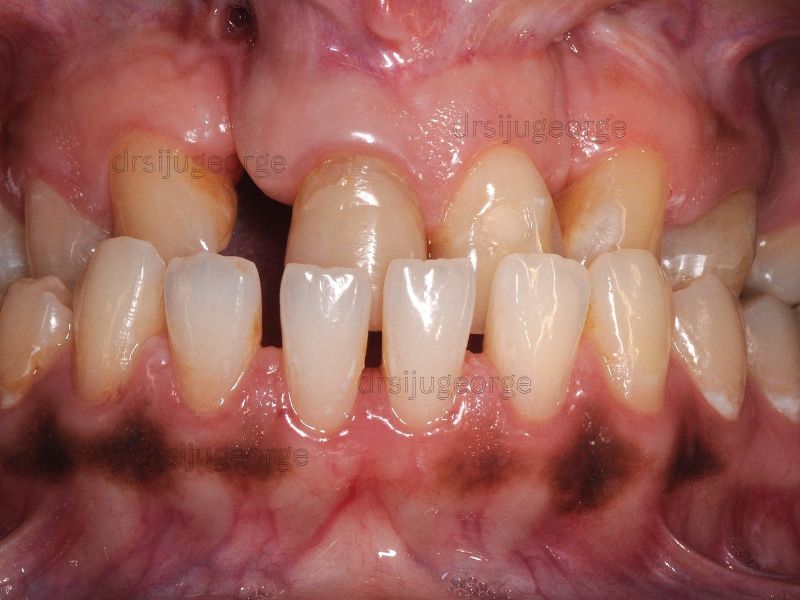
Before treatment — in their own words
She came not because of her bite, but because a new dentist had noticed that her back teeth showed unusual wear patterns and had asked whether she had ever considered orthodontic treatment. She had not. Her teeth had always looked this way. The crossbite had been present since childhood — she had photographs going back to her teenage years where the bilateral narrowing was already visible. It had simply never been diagnosed or discussed.
She was in her late thirties. The mouthguard had protected her enamel from the grinding but had done nothing for the bite that was generating it. She wanted to know if anything could still be done.
The clinical picture
The examination revealed a complete bilateral posterior crossbite — both sides — with the upper posterior teeth sitting inside the lower on both left and right. An anterior open bite tendency was present, and the skeletal pattern had a mild Class III element. Bruxism facets were visible on the posterior teeth and incisal edges, consistent with years of parafunctional wear. The dental arches were both narrow, the upper more severely so. Periodontal health was good, with no bone loss despite the wear history.
The plan
Invisalign Comprehensive treatment was planned with bilateral arch expansion as the primary objective, combined with bite ramps incorporated into the aligners to manage the anterior open bite tendency and partially deprogramme the bruxism habit during treatment. Both arches required expansion and alignment. Attachments were placed at key positions to generate the forces needed for posterior expansion. The treatment plan was discussed in detail, including realistic expectations about the relationship between crossbite correction and bruxism reduction — the bite would improve, but long-term bruxism management would require a separate occlusal splint post-treatment.
The outcome
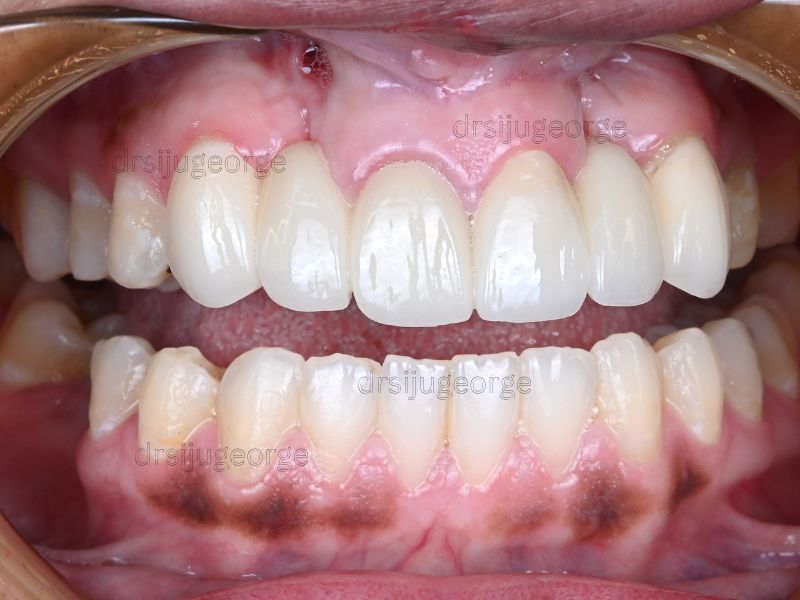
Eighteen months later, the bilateral crossbite was fully corrected. Both posterior segments were in correct buccal occlusion. The anterior open bite tendency had resolved. The patient reported a significant reduction in morning jaw soreness during the second half of treatment, which she attributed to the improved bite position. A post-treatment occlusal splint was provided for nighttime wear to protect the new occlusion and manage residual parafunctional activity.
She has not needed a new mouthguard since the original one wore out. The splint is thinner, less intrusive, and worn nightly as a maintenance measure — not as an emergency intervention.
Clinical notes (for dental professionals)
- Diagnosis: Bilateral posterior crossbite; mild Class III skeletal tendency; anterior open bite tendency; bruxism with posterior wear facets; constricted upper and lower arches
- Treatment: Invisalign Comprehensive; bilateral upper and lower arch expansion; bite ramps incorporated in aligners
- Auxiliaries: Expansion attachments bilateral premolars and first molars; IPR anterior segments; Class III elastics for skeletal camouflage
- Extractions: None
- Duration: 18 months · Refinement performed
- Retention: Vivera upper and lower plus post-treatment hard acrylic occlusal splint for bruxism management